Make-It-Poseable:
Feed-forward Latent Posing Model for 3D Characters

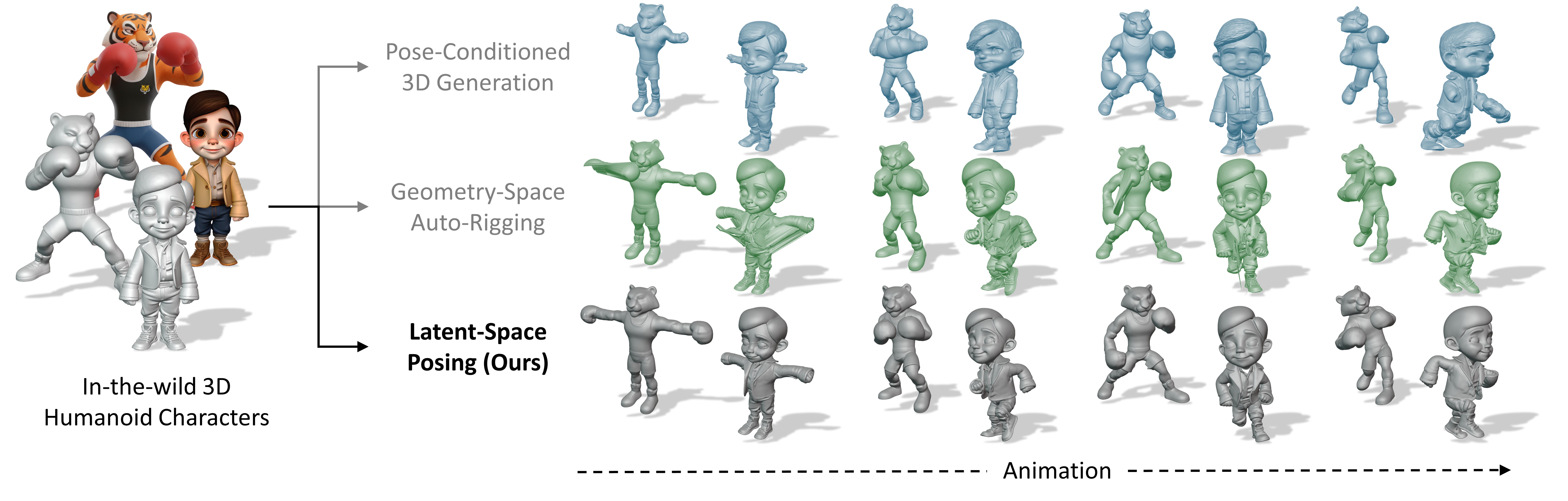
Make-It-Poseable re-poses any 3D character model in a single feed-forward pass. Unlike auto-rigging or generative approaches that often suffer from skinning artifacts or limited controllability, our latent posing paradigm robustly handles challenging cases and produces high-fidelity results.

Abstract

Posing 3D characters is a fundamental task in computer graphics. However, existing paradigms, ranging from traditional auto-rigging to recent pose-conditioned generative models, frequently struggle with inaccurate skinning weights, fixed mesh topologies, and poor pose conformance. These challenges have become particularly pronounced with the recent explosion of AI-generated 3D assets, which often exhibit flawed structures and fused geometry.

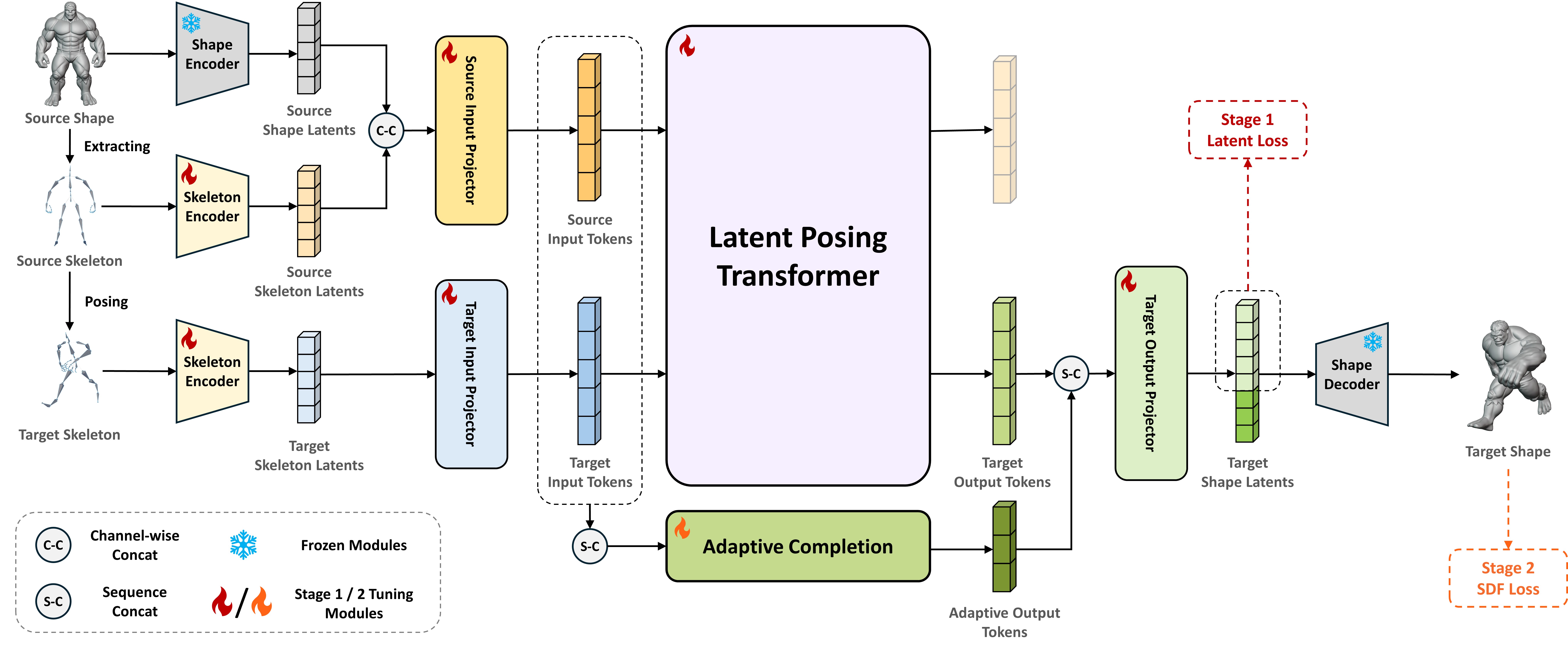
To address these issues, we introduce Make-It-Poseable, a novel feed-forward framework that reformulates character posing as a skinning-free latent-space transformation problem. By decoupling shape deformation from the constraints of fixed mesh connectivity, our method directly operates on compact latent representations to reconstruct characters in target poses. To achieve this, our framework integrates a latent posing transformer for shape manipulation, a dense pose representation for fine-grained control, and an adaptive completion module optimized via a bipartite-matched latent loss to robustly handle topological changes.

Extensive experiments demonstrate that our method significantly outperforms existing baselines in posing quality. Furthermore, our skeleton-agnostic design exhibits remarkable zero-shot generalization to diverse morphologies including quadrupeds and seamlessly supports various 3D authoring applications such as part replacement and refinement.
pipline_figure

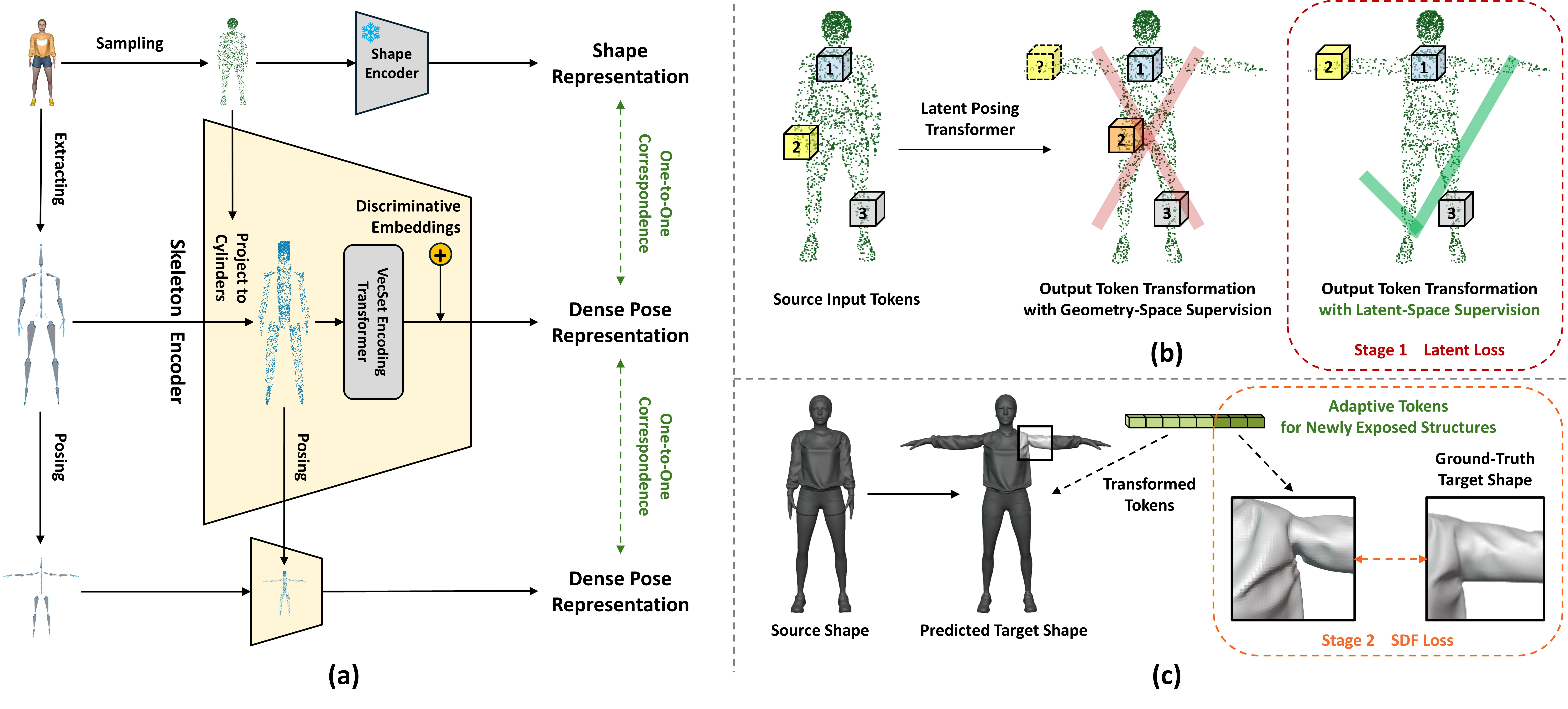
Design Details

(a) The skeleton encoder produces dense pose representations with latent-level one-to-one correspondence.
(b) Latent-space supervision ensures a semantically meaningful token transformation path to preserve geometric details.
(c) Adaptive completion is introduced in the finetuning stage to handle newly exposed structures after posing.

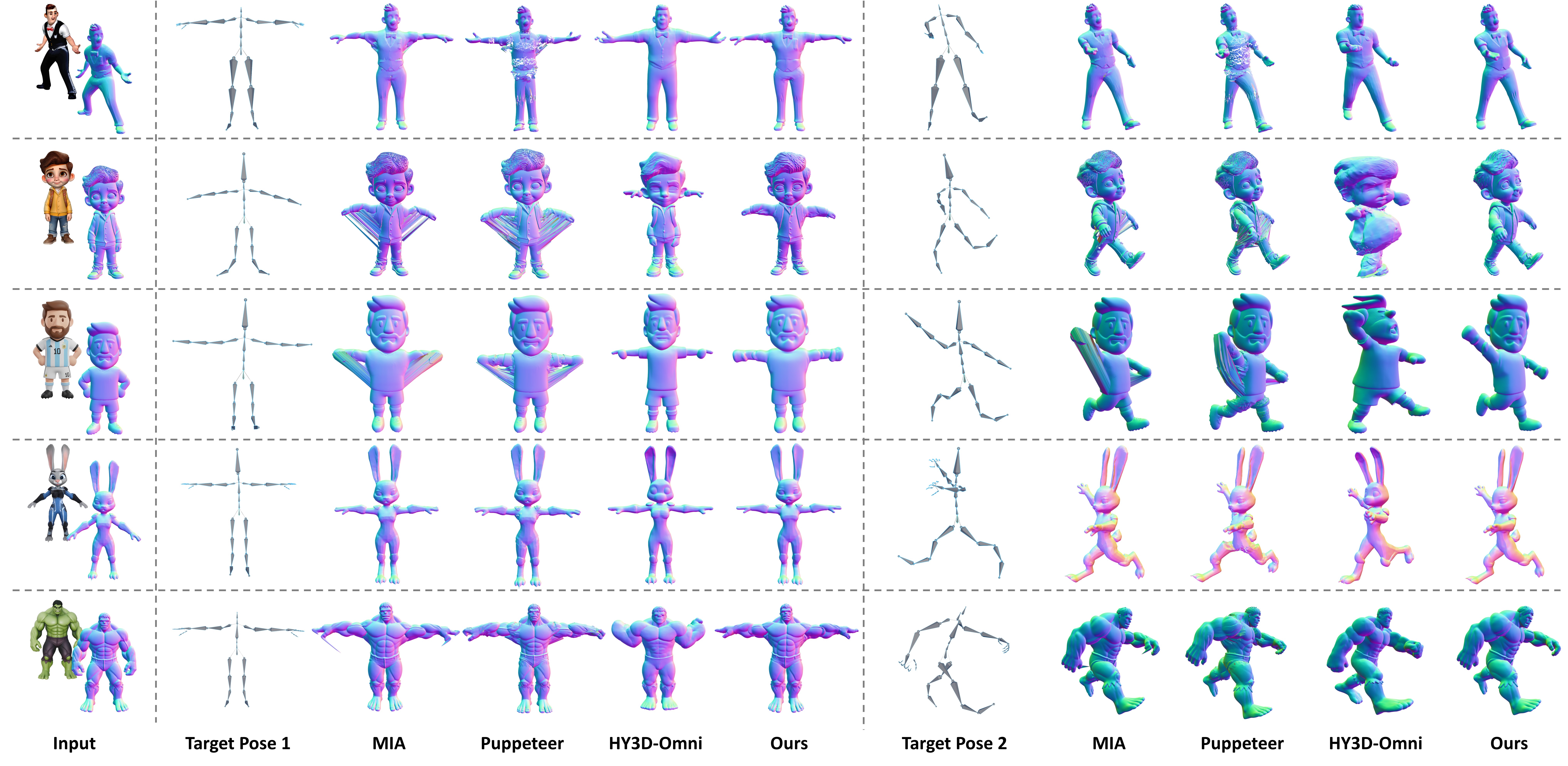
Qualitative Comparison

Make-It-Poseable produces high-fidelity results across various cases. It robustly handles challenging inputs where auto-rigging methods produce significant artifacts, and gives better pose conformance and detail preservation compared to the pose-conditioned 3D generation method.

Web Demo

A Gradio-based demo for interactive posing workflow:

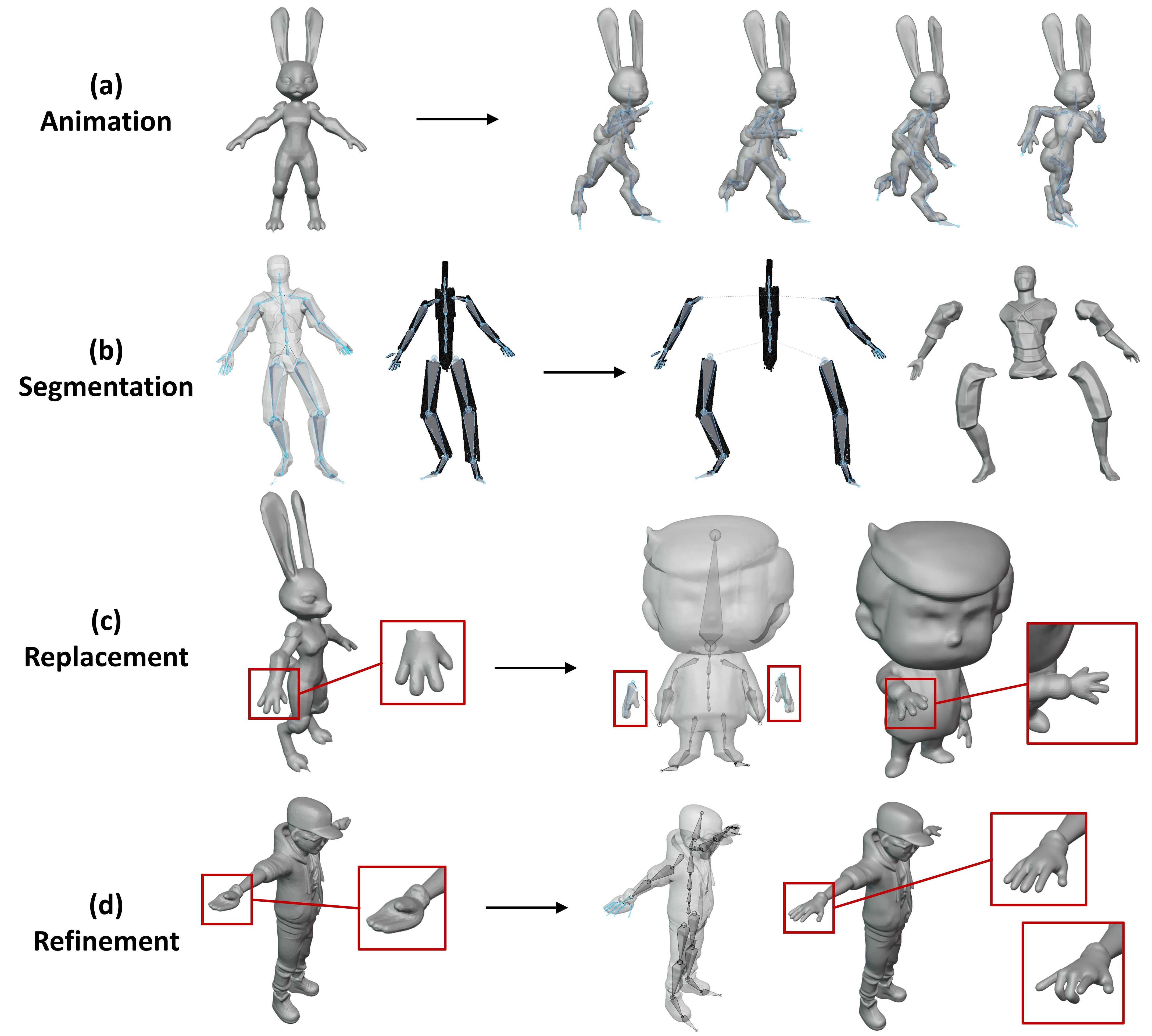
Applications

Make-It-Poseable can serve as a robust pre-rigging geometry refiner for downstream animation. This can be realized by first re-posing a defective input mesh into a clean rest pose with limbs fully extended, and then rigging and animating it using standard pipelines. This integrates seamlessly with existing graphics workflows while effectively resolving the skinning and topology issues by providing a clean base character.

The fine-grained and flexible control offered by our latent-space modeling also enables some 3D shape editing applications.

Citation

@article{guo2025make,
    author={Guo, Zhiyang and Zhang, Ran and Xiang, Jinxu and Zhao, Alan and Yuan, Zhenxun and Zhou, Wengang and Li, Houqiang},
    title={Make-It-Poseable: Feed-forward Latent Posing Model for 3D Characters},
    journal={arXiv preprint arXiv:2512.16767},
    year={2025},
}